
Self-publishing in Canada involves a specific set of administrative and logistical steps that differ from the American experience more than most authors expect. The ISBN system, the distribution infrastructure, the principal retail accounts, and the public library deposit requirements all have Canadian-specific details worth understanding before a manuscript reaches the production stage.
Step 1: Obtain an ISBN
Library and Archives Canada administers ISBN assignment for Canadian publishers at no charge. This is a meaningful difference from the American market, where ISBNs are purchased through Bowker. In Canada, each format of a book — print, epub, PDF — requires its own ISBN. An author publishing a paperback and an ebook needs at minimum two ISBNs.
Registration is completed online through the LAC publisher registration portal. Processing takes approximately five to ten business days for new publisher accounts. An author publishing independently is considered the publisher and should register under their publishing name or a small press imprint name — not their personal name, which creates metadata problems when a second title is published later.
Publisher Imprint Name
Choosing an imprint name early avoids complications. The imprint appears on the copyright page, in library catalogue records, and in Indigo and Amazon metadata. A name that signals an independent press rather than a personal project tends to be catalogued and shelved more consistently by retailers and library systems. It does not need to be incorporated — a sole proprietorship operating under a business name is sufficient for most publishing purposes.
Step 2: Book Production
Production for a self-published title in Canada involves at minimum three distinct stages: interior layout, cover design, and proofreading. Authors who complete the writing and developmental work themselves but engage professionals for production consistently report fewer distribution and retail-placement problems.
Interior Layout
Interior layout software options used by Canadian independent publishers include Adobe InDesign (industry standard), Affinity Publisher (a lower-cost alternative with comparable output quality), and Vellum (Mac-only, strong for ebook output). The output requirements for print-on-demand differ from offset print in trim size tolerances and bleed specifications. IngramSpark's specifications for the Canadian market are documented in their online file creation guide.
Cover Design
A cover designed for print-on-demand must be provided as a single flat PDF that includes the spine and back cover alongside the front. Spine width is calculated from the page count and paper type — IngramSpark provides a spine width calculator. The barcode with the ISBN should appear on the back cover; some POD distributors add this automatically if the ISBN is entered correctly during title setup.
Step 3: Print-on-Demand Distribution
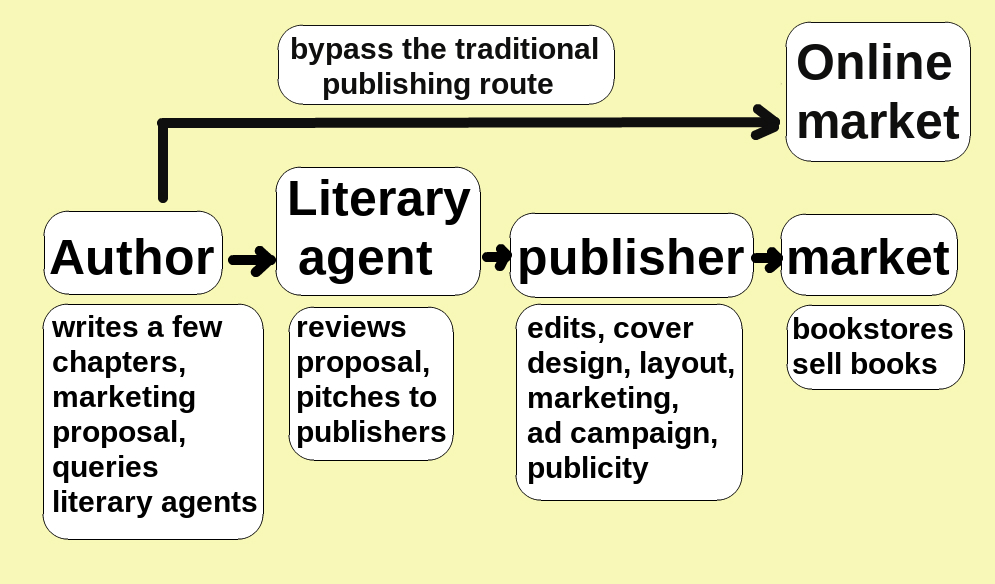
IngramSpark is the primary POD distributor used by Canadian self-publishing authors who want broad retail placement. Ingram's distribution network covers Chapters Indigo, independent Canadian booksellers through the BookNet Canada system, and library wholesalers including McNaughton & Gunn Canada. Amazon's KDP Print also offers POD, but its distribution outside Amazon's own retail channel is substantially more limited in Canada.
The practical difference: a title on IngramSpark with expanded distribution enabled can be ordered by any Canadian bookseller through their existing Ingram account. A title on KDP Print alone is effectively invisible to independent Canadian bookstores unless the author maintains a separate Ingram account for wholesale.
Pricing and Wholesale Discount
Setting an appropriate retail price and wholesale discount is more consequential than it first appears. Canadian booksellers require a minimum 40% discount to order a title for stock (as opposed to special order). The author's per-copy royalty is determined by the retail price minus the printing cost minus the distributor's commission. IngramSpark's royalty calculator allows modelling across different retail prices and trim sizes before committing to a title setup.
Step 4: Ebook Distribution
Ebook distribution to Kobo, which holds a meaningful share of the Canadian ebook market, is available through direct upload to Kobo Writing Life, through Draft2Digital, or through IngramSpark's ebook channel. Authors focused on the Canadian market should not default to Amazon KDP Select exclusivity, which prohibits distribution to Kobo and other retailers.
Public libraries in Canada use the OverDrive/Libby platform for ebook lending. OverDrive acquisition is handled through publishers and distributors rather than directly through authors; titles distributed through IngramSpark or Draft2Digital are eligible for library acquisition through those channels.
Step 5: Legal Deposit
Canadian federal law requires publishers to deposit copies of each new title with Library and Archives Canada. For print titles, two copies are deposited. The legal deposit obligation applies to self-publishing authors in the same way it applies to commercial publishers. The LAC legal deposit page provides current instructions and mailing addresses for each region.
Many provinces maintain their own legal deposit programs in addition to the federal requirement. British Columbia, Alberta, Quebec, and Ontario each have provincial library legal deposit systems. Authors publishing under a Canadian imprint should confirm the applicable provincial requirements.
Step 6: Retail Placement and Discoverability
Metadata quality determines how discoverable a title is within retail and library systems. BISAC subject codes, which categorize books by genre and topic within the BookNet Canada cataloguing system, should be selected deliberately. Two or three BISAC codes that accurately reflect the book's content perform better in search than a broad selection of marginally relevant codes.
The BookNet Canada bibliographic data system connects publisher metadata to Canadian bookseller inventory systems. Titles distributed through Ingram are typically picked up by this system automatically, but authors should verify their title metadata through the BookNet Canada SalesData portal after distribution setup is complete.
Timeline Expectations
A realistic timeline from final manuscript to available-for-purchase in Canadian retail channels runs approximately 16 to 24 weeks when professional production and standard distribution channels are involved. The ISBN registration and legal deposit steps each add time at the beginning and end of the process. Authors who compress this timeline by skipping production stages or using author copies as deposit copies often encounter metadata and cataloguing problems that take additional months to correct.
Last updated:

